Truth Bee Told
By Lillian Naftel
Shenandoah Valley Conservancy focuses on many aspects of land conservation. We often work to protect the working farms of the Valley, with the goal not being land preservation alone. We want to ensure the long-term food security and sustainability of our farms for generations.
Many of the major food and fiber crops grown throughout the Valley require a crucial step in the production process, often forgotten by citizens and conservationists alike. Deeply connected to agriculture everywhere in the world are pollinators.
Pollination is an essential ecosystem service. While honey bees are perhaps the most recognizable pollinators, they are only one part of a much larger community of animals that move pollen between flowers. In Virginia, that community includes hundreds of species of wild bees as well as butterflies, moths, beetles, flies, and other insects. In other parts of the world, birds and bats are also contributors to pollination.
Wild Bees
Understanding bees and pollinators requires going beyond managed honeybee colonies. Research has documented approximately 500 bee species in Virginia, representing a remarkable diversity of pollinators with different life cycles, nesting behaviors, and relationships with plants (Adamson et al., 2012).
Wild bees contribute to crop pollination throughout the growing season. A study focused in Virginia examined crop flowers from April through August found that non-Apis bees (wild bees) accounted for between 68% and 83% of bee visits to several important crops, including apples, blueberries, cranberries, and cucurbits. Researchers recorded 105 species of non-Apis bees visiting crop flowers, demonstrating the diversity of pollinators contributing to Virginia agriculture (Adamson et al., 2012). In several crops, wild bees were more frequent visitors than honeybees.
Honeybees are valuable agricultural pollinators, but wild bees can provide substantial pollination services without being transported to farms or maintained in artificial colonies.
Beekeeping
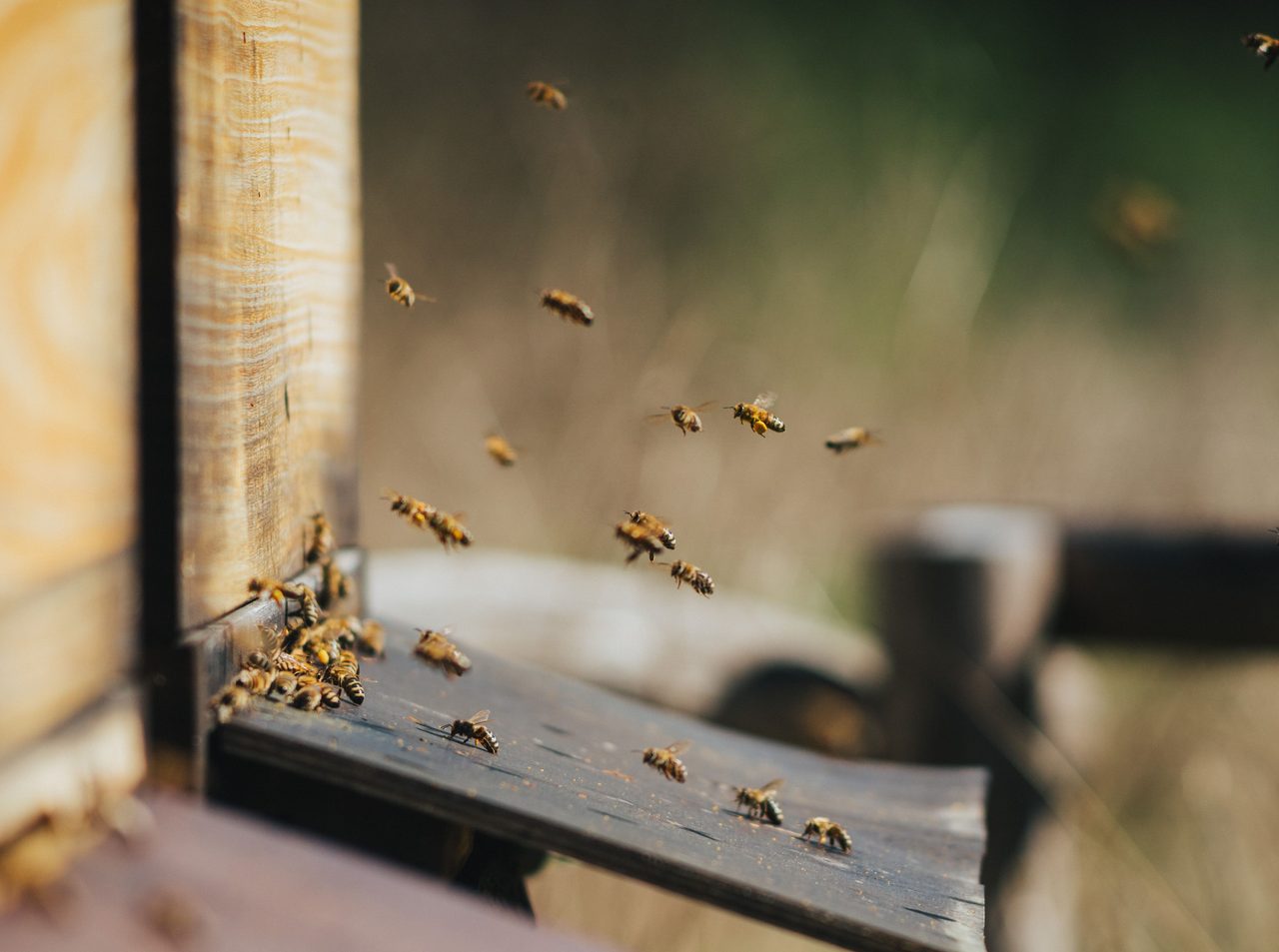
Beekeeping has long been a part of life in Virginia. Today, beekeepers range from individuals maintaining a few colonies in their backyards to larger operations managing colonies for honey production, colony sales, and agricultural pollination. Local organizations, including the Shenandoah Valley Beekeepers Association, provide educational resources and connections for people interested in beekeeping in the region.
Beekeeping can also provide an accessible entry point into conservation. People who begin keeping bees often become more aware of flowering plants, pesticide use, seasonal changes, and the relationship between agriculture and insects. This connection can encourage landowners to plant flowers, reduce unnecessary pesticide applications, and pay closer attention to the health of their local ecosystems.
Keeping honeybees successfully requires much more than placing a hive on a property and allowing the colony to survive without management. Honeybee colonies face numerous threats, including parasites, pathogens, pesticide exposure, poor nutrition, and changing environmental conditions.
One of the greatest challenges is the parasitic mite Varroa destructor. Varroa mites feed on developing and adult honeybees and can transmit viruses that contribute to colony decline. Research has identified Varroa destructor as one of the most significant threats to honeybee health worldwide, while the development of resistance to some acaricides has made effective mite management increasingly challenging (Traynor et al., 2020).
Disease is also a significant issue in Virginia. In a study of more than 300 honeybee hives sampled across the Commonwealth, researchers found that Nosema ceranae was the dominant Nosema species, with approximately 69.3% of sampled hives infected (Traver & Fell, 2011).
This means that successful beekeeping should be maintained as an active practice. Maintaining healthy colonies requires education and attention throughout the year rather than simply increasing the amount of hives on the landscape.
Honeybees represent only one species among Virginia’s diverse bee population. Native bees include bumble bees, mason bees, leafcutter bees, carpenter bees, mining bees, sweat bees, and many others. These species vary greatly in size, behavior, nesting habits, and the plants they pollinate.
Unlike honeybees, the majority of native bees cannot simply be transported to a flowering crop to begin pollinating. Their populations depend on year-round habitat, including diverse flowers as well as suitable nesting sites in the ground, old wood, hedgerows, and surrounding natural areas.
This distinction is important in the Shenandoah Valley. A beekeeper can manage honeybee colonies by providing hives and monitoring colony health, but native bees require a functioning landscape. All of the aspects of an undisturbed landscape contribute resources that cannot be replaced simply by adding more honeybee hives.
Research shows that wild bees can provide valuable pollination services throughout the year. Their abundance and diversity also create a degree of resilience within agricultural systems. When many pollinator species are present, the loss or decline of one species does not necessarily eliminate pollination services altogether (Adamson et al., 2012; Winfree & Kremen, 2009).
Agricultural Allies
Bees are not the only animals that connect healthy landscapes with productive ecosystems. Around the world, bats provide a remarkable range of ecological services, including insect suppression, seed dispersal, and pollination.
Bat pollination is particularly important in tropical and subtropical ecosystems. Nectar- and fruit-eating bats visit flowers in search of food and can transfer pollen between plants as they move among flowers. A global review of bat ecosystem services identified 549 plant species that are either dispersed or pollinated by bats, demonstrating that bats can play a significant role in plant reproduction in ecosystems where bat pollination has evolved (Ramírez-Fráncel et al., 2022). Earlier research similarly documented pollination as one of the major ecosystem services provided by bats worldwide (Kunz et al., 2011).
The relationship between bats and pollination is therefore important to recognize, but it also requires some regional context. Most bats found in Virginia are insectivorous rather than nectar-feeding pollinators. For the Shenandoah Valley, the more immediate agricultural benefit of bats is their ability to consume large numbers of insects. Insectivorous bats can contribute to natural pest suppression, providing an ecosystem service that complements the pollination services provided by bees and other pollinators (Kunz et al., 2011; Ramírez-Fráncel et al., 2022).
This makes bats an important part of the Valley’s broader agricultural ecosystem. A healthy farm landscape does not depend on a single species or even a single group of pollinators. Instead, it supports a network of species that perform different functions. Bees move pollen between flowers during the day, while bats emerge at night and forage on insects. Together with birds, butterflies, moths, beetles, flies, and other organisms, these species contribute to the ecological processes that allow agricultural landscapes to function.
Protecting habitat for bats can therefore complement efforts to protect pollinators. Mature trees, forest edges, wetlands, riparian corridors, and other natural areas can provide important habitat for bats while simultaneously supporting wild bees and other wildlife. Conservation of these areas creates a landscape in which multiple ecosystem services can operate together.
Pollinator-Friendly Land Management
Knowing the reliance that wild pollinators have on natural habitats, conservation efforts can be focused on preserving existing habitats while also creating new pollinator habitat.
A recent Sustainable Agriculture Research and Education project at the Virginia Tech Alson H. Smith Jr. Agricultural Research and Extension Center established a half-acre wildflower plot specifically tailored to the Shenandoah Valley region. The project emphasized that regional specificity is important because locally appropriate plants are more likely to establish successfully, require less additional care, and avoid introducing non-native invasive species. The planting included one annual species and 21 perennial species, creating the potential for longer-term floral resources (SARE, 2023).
This project provides a useful model for pollinator conservation in the Valley. Rather than assuming that any flower planting will benefit bees equally, habitat projects should consider which plants are appropriate for the region, when they bloom, and whether they provide resources across the growing season.
Pollinator habitat is not limited to specially designed gardens. Grasslands, forests, field borders, shrublands, wetlands, and other seminatural habitats can all provide floral, nesting, roosting, and foraging resources. Maintaining a diversity of habitats can benefit different species at different points in their life cycles.
This approach also demonstrates why conservation on working farms can have benefits extending beyond the boundaries of a single field. Hedgerows, forest edges, riparian areas, grasslands, and other seminatural features can provide habitat for wild bees while also supporting bats and other wildlife.
The USDA Natural Resources Conservation Service and Virginia Tech recently conducted a nationwide assessment of conservation practices intended to benefit pollinators. Researchers identified 51 NRCS conservation practices likely to provide benefits for pollinator habitat. These practices accounted for approximately 2.5% of the nation’s seminatural habitat but supported an estimated 3.9% of the national supply of pollinators. The researchers concluded that conservation practices can provide a disproportionately large contribution to pollinator habitat relative to the amount of seminatural habitat they occupy (Olimpi et al., 2024).
For the Shenandoah Valley, this reinforces the importance of viewing farms as part of larger ecological landscapes. Protecting working farmland does not have to mean choosing between agriculture and conservation. Properly managed farms can provide food while also maintaining habitat for the organisms that make healthy agricultural systems possible.
Pollinators need more than a single flowering season. They need landscapes that provide food, nesting habitat, shelter, and protection throughout the year. Bees need flowers and nesting sites. Bats need places to roost and forage for insects. Other pollinators and wildlife depend on many of the same connected habitats.
Conserving these landscapes is therefore not simply about protecting individual species. It is about maintaining ecological relationships that allow the Shenandoah Valley’s farms, forests, and communities to remain productive and resilient for generations.
References
Adamson, N. L., Roulston, T. H., Fell, R. D., & Mullins, D. E. (2012). From April to August—Wild bees pollinating crops through the growing season in Virginia, USA. Environmental Entomology, 41(4), 813–821. https://doi.org/10.1603/EN12073
Kunz, T. H., Braun de Torrez, E., Bauer, D., Lobova, T., & Fleming, T. H. (2011). Ecosystem services provided by bats. Annals of the New York Academy of Sciences, 1223(1), 1–38. https://doi.org/10.1111/j.1749-6632.2011.06004.x
Olimpi, E. M., et al. (2024). Three key findings from first-of-its-kind study on NRCS conservation practices and U.S. pollinators. USDA Natural Resources Conservation Service.
Ramírez-Fráncel, L. A., et al. (2022). Bats and their vital ecosystem services: A global review. Integrative Zoology, 17(2), 171–193. https://doi.org/10.1111/1749-4877.12552
Sustainable Agriculture Research and Education. (2023). Progress report for GS23-291: Establishing a Shenandoah Valley-specific wildflower plot for pollinator habitat.
Traver, B. E., & Fell, R. D. (2011). Prevalence and infection intensity of Nosema ceranae in honey bee (Apis mellifera) colonies in Virginia. Journal of Invertebrate Pathology, 107(1), 43–49.
Traynor, K. S., Mondet, F., de Miranda, J. R., Techer, M., Kowallik, V., Oddie, M. A. Y., Chantawannakul, P., & McAfee, A. (2020). Varroa destructor: A complex parasite, crippling honey bees worldwide. Trends in Parasitology, 36(7), 592–606.
Winfree, R., & Kremen, C. (2009). Are ecosystem services stabilized by differences among species? A test using crop pollination. Proceedings of the Royal Society B: Biological Sciences, 276(1655), 229–237